
You sit down, open your notebook and learn twenty new English words. You feel great. The next morning you try to use them… and only five come back. By next week, maybe two.
If this sounds familiar, here is the good news: there is nothing wrong with your brain. You are simply fighting a natural process that every human being experiences. Once you understand it, you can use it to your advantage.
The forgetting curve: what really happens to new words
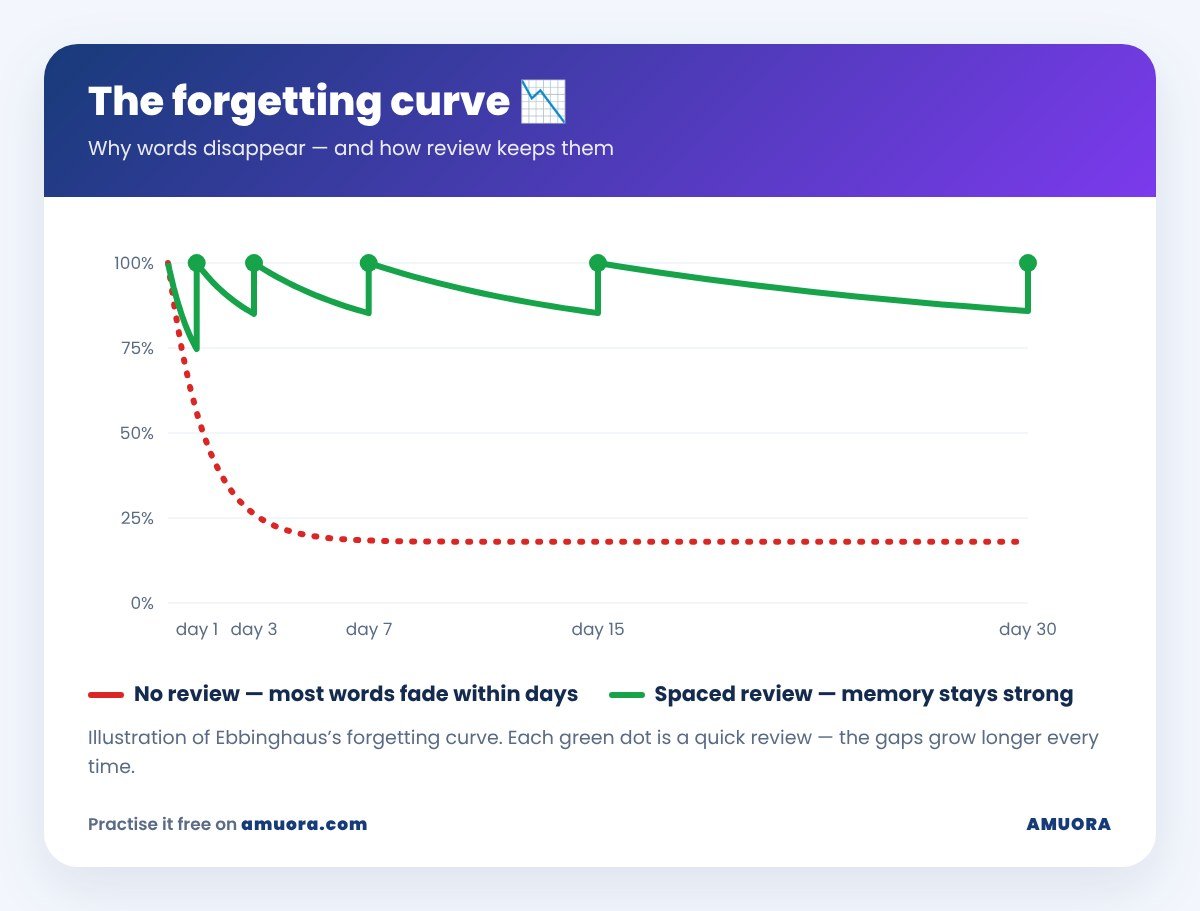
In the 1880s, the German psychologist Hermann Ebbinghaus spent years testing his own memory. He discovered a pattern that scientists have confirmed again and again since then: without review, we lose a large part of new information within the first day, and most of it within a week. He called this the forgetting curve.
Your brain is not being lazy. It is being efficient. Every day it receives thousands of pieces of information, and it keeps only what seems important. How does it decide what is important? Mostly by one signal: “Did I need this again?”
The fix: review just before you forget
Ebbinghaus also found the solution. Each time you successfully remember something, the memory becomes stronger and the curve becomes flatter. After a few well-timed reviews, a word can stay with you for months or years.
This method is called spaced repetition. Instead of repeating a word 50 times in one evening, you review it at growing intervals:
- Day 1 — learn the word
- Day 2 — first quick review
- Day 4 — second review
- Day 8 — third review
- Day 16, then day 35… — the gaps keep growing
Each review takes only seconds. The secret is not how long you study, but when.
Ten minutes of well-timed review can do more for your memory than an hour of cramming the night before an exam.
Three mistakes that make you forget faster
1. Learning words in long lists
Lists feel productive, but your brain stores words better in context. Always learn a word with a short example sentence — ideally one you write yourself.
2. Only reading, never recalling
Looking at a word and its meaning is passive. Covering the meaning and trying to remember it is active recall, and it is many times more powerful. The small effort of “trying to remember” is exactly what tells your brain: this matters.
3. Studying a lot, but not every day
Two hours on Sunday is less effective than fifteen minutes every day. Short daily sessions keep the review schedule alive.
How to do it without a calendar
Calculating review dates for hundreds of words by hand is impossible. That is why modern learners use apps that do the scheduling automatically. On AMUORA, every word you learn goes into your Smart Review. The system shows each word at the right moment — and when you answer correctly, the next review is pushed further into the future.
Your only job is to open the app every day and clear your review list. It usually takes less than ten minutes.
Try this today: learn 5 new words, write one sentence for each, and review them tomorrow before you learn anything new. Notice how much more you remember.
A simple daily routine
- Review first (3–5 minutes): clear the words that are due today.
- Learn something new (3–5 minutes): 5 to 7 new words with examples.
- Use them (2 minutes): say one sentence out loud with a new word, or use it in a chat.
That is it. Ten minutes. Do it for 30 days and you will have 150–200 words that actually stay — not 600 words that disappear.
Final thought
Forgetting is not failure. It is part of learning. Every time you almost forget a word and then remember it, you make that memory stronger. So be kind to yourself, keep your sessions short, and show up every day.
Your words are waiting — and it takes less than 10 minutes.