
“I’m intermediate.” “My English is good.” “I’m a beginner, but I understand a lot.” These descriptions mean very different things to different people. That is why schools, universities and employers around the world use one shared scale: the CEFR (Common European Framework of Reference for Languages).
The CEFR has six levels, from A1 to C2. Knowing your level helps you choose the right materials, set clear goals and show your English on a CV.
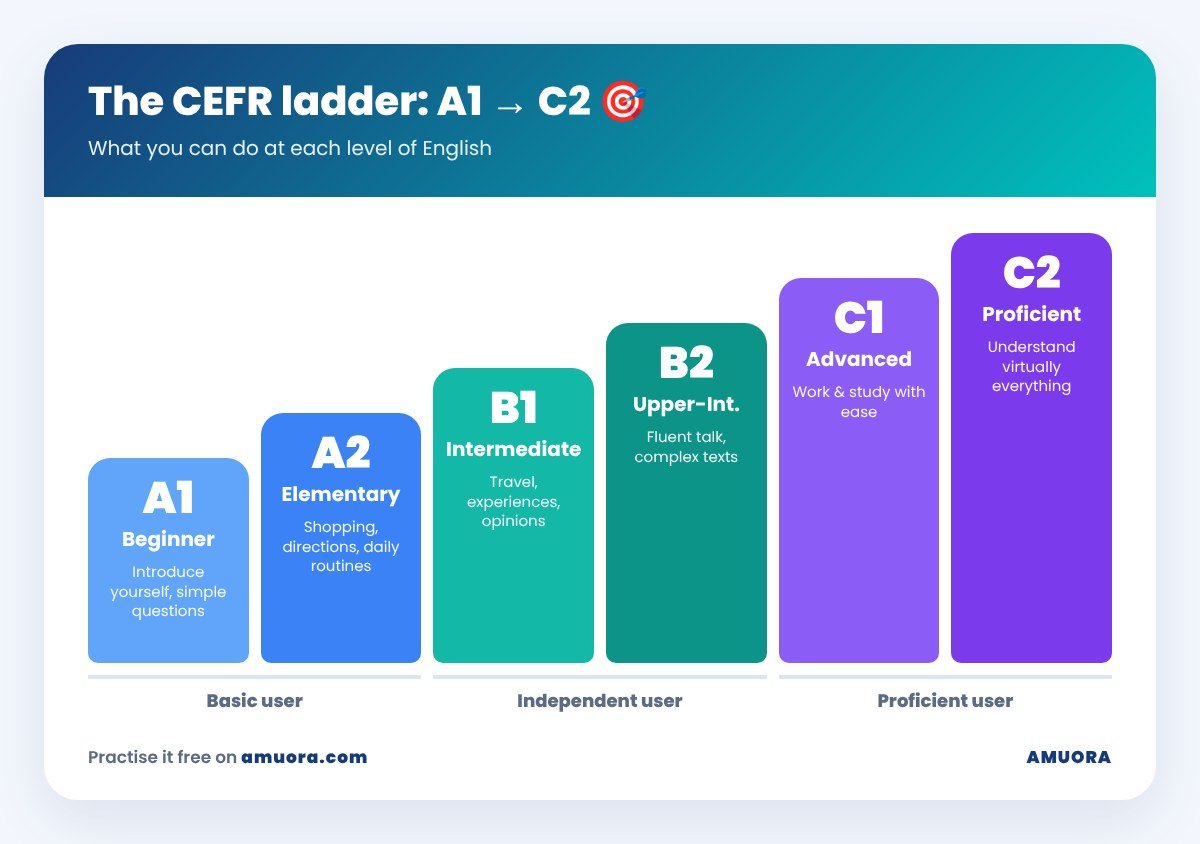
A — Basic user
A1 · Beginner
You can introduce yourself, ask and answer simple questions about personal details and understand very slow, clear speech. “My name is Ali. I am from Kabul. I like football.”
A2 · Elementary
You can handle simple, routine tasks: shopping, directions, talking about your family and your job in simple sentences. You understand short, clear messages and announcements.
B — Independent user
B1 · Intermediate
You can deal with most situations while travelling, describe experiences, dreams and plans, and give short reasons for your opinions. Many learners feel this is when English “opens up”.
B2 · Upper-Intermediate
You can talk with native speakers fairly fluently, understand the main ideas of complex texts and write clear, detailed texts on many subjects. Many universities and employers ask for B2.
C — Proficient user
C1 · Advanced
You express yourself fluently and spontaneously, use English flexibly for social, academic and professional purposes and understand long, demanding texts — including implied meaning.
C2 · Proficiency
You understand virtually everything you hear or read and can express yourself very precisely, even in complex situations. This is a very high level that few learners need.
How long does each level take?
It depends on your first language, your age, your goals and how you study. As a rough guide, Cambridge English estimates that each level takes a few hundred hours of guided learning — roughly 180–200 hours to reach A2 and around 500–600 hours to reach B2. Daily practice and lots of listening and reading can make the journey faster.
Levels are not fixed. You may be B1 in reading and A2 in speaking. That is completely normal — it simply shows you where to focus next.
How IELTS bands roughly compare
- B1 ≈ IELTS 4.0–5.0
- B2 ≈ IELTS 5.5–6.5
- C1 ≈ IELTS 7.0–8.0
- C2 ≈ IELTS 8.5–9.0
Find your real level in 30 minutes
AMUORA’s free Level Test checks vocabulary, grammar, reading, listening and writing — your writing is even assessed by AI. You get your CEFR level and a personal plan. When you are ready, you can get a beautiful certificate with a public verification link to add to your CV or LinkedIn.
Know your level. Set your goal. Track your progress.