
“I did a mistake.” “There was strong rain.” “Can you make a photo of me?”
Every word in these sentences is correct English. The grammar is fine. And yet a native speaker immediately hears that something is not quite right. Why? Because English words have favourite partners. These natural word combinations are called collocations.
What is a collocation?
A collocation is a pair or group of words that native speakers naturally use together. There is often no logical reason — it is simply how the language works. We say heavy rain but strong wind; we make a mistake but do homework.
Collocations are one of the clearest differences between intermediate and advanced learners. Learn them, and your English instantly sounds more fluent — without learning a single new grammar rule.
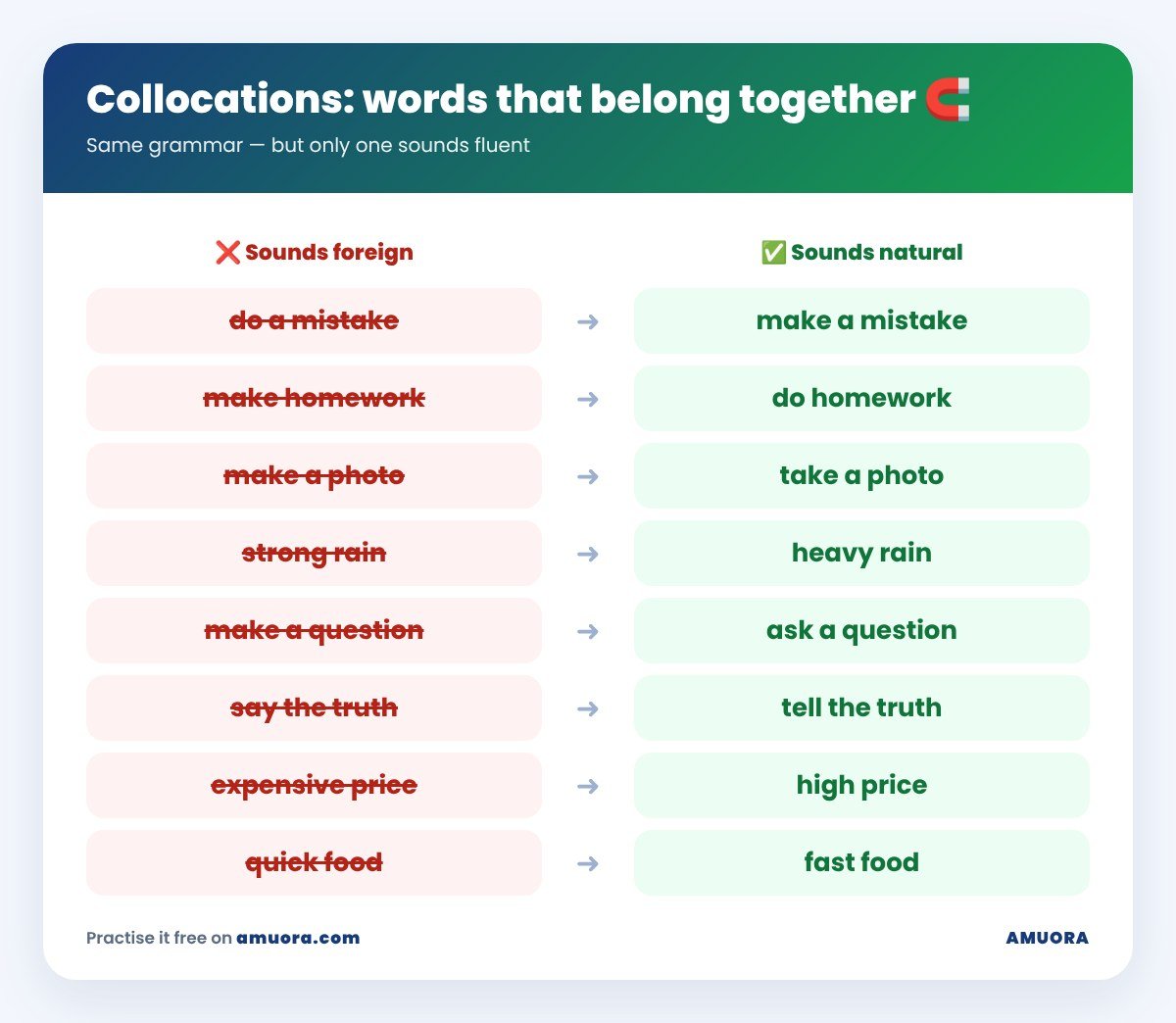
MAKE vs DO
A simple guide: make is often about creating or producing something; do is often about tasks, jobs and activities. But many expressions just need to be learned.
- make a mistake, a decision, a plan, progress, an effort, friends, money, a phone call, noise
- do homework, the dishes, business, exercise, your best, a favour, research
The 20 collocations to fix today
- make a mistake — not
do a mistake - do homework — not
make homework - take a photo — not
make a photo - heavy rain — not
strong rain - strong coffee — not
powerful coffee - fast food — not
quick food - ask a question — not
make a question - tell the truth — not
say the truth - pay attention — not
give attention - make a decision — not
do a decision - take a break — not
do a break - catch a cold — not
take a cold - high price — not
expensive price - make progress — not
do progress - give advice — not
say an advice(and remember: advice is uncountable!) - keep a promise — not
hold a promise - save time / waste time
- meet a deadline — finish on time
- highly recommend — “I highly recommend this book.”
- bitterly cold — extremely cold
Learn chunks, not words. When you learn a new noun, also learn the verb that goes with it. Don’t just learn “decision” — learn “make a decision”. Your notebook should be full of chunks.
How to notice collocations
- When you read, underline word pairs that appear together.
- When you check your writing, ask: “Would a native say these two words together?”
- Use an AI writing coach — it often suggests the natural collocation instead of a word-by-word translation.
On AMUORA, the Collocations deck shows you the right combination (and the common wrong one), with audio and examples. And the Writing Coach marks unnatural word combinations in your own texts.
Flip cards + quiz. Five minutes, and your English sounds more natural.