
English has around 44 sounds but only 26 letters. That is why spelling and pronunciation so often feel like two different languages — and why even advanced learners sometimes say sheep when they mean ship.
The key to clear pronunciation is not a perfect native accent. It is making the difference between sounds that change the meaning of a word. Linguists call these word pairs minimal pairs.
What is a minimal pair?
A minimal pair is two words that are identical except for one sound: ship / sheep, very / wary, think / sink. If you can hear and say the difference, people will understand you easily — even with an accent.
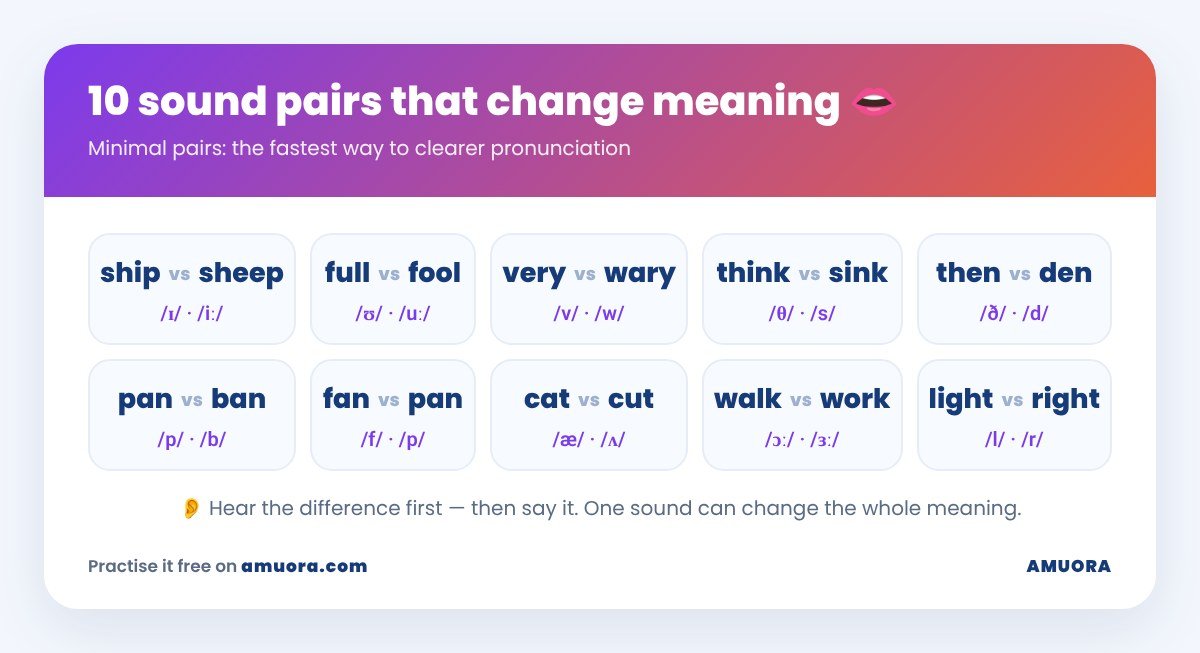
The 10 pairs that matter most
1. ship /ɪ/ vs sheep /iː/
The /iː/ in sheep is long and tense — smile a little. The /ɪ/ in ship is short and relaxed. Try: live / leave, fill / feel, bit / beat.
2. full /ʊ/ vs fool /uː/
Same idea with round lips: short and relaxed for full, long and tight for fool.
3. very /v/ vs wary /w/
For /v/, your top teeth touch your bottom lip and you feel a buzz. For /w/, your lips make a small circle and do not touch your teeth.
4. think /θ/ vs sink /s/
Put the tip of your tongue lightly between your teeth and blow gently. It feels strange — that is normal!
5. then /ð/ vs den /d/
The voiced version of /θ/: same tongue position, but add your voice.
6. pan /p/ vs ban /b/
Speakers of Arabic and some other languages often mix these. Put your hand in front of your mouth: /p/ releases a small puff of air, /b/ uses your voice.
7. fan /f/ vs pan /p/
/f/ is a continuous sound through your teeth and lip; /p/ is a short “pop” with both lips.
8. cat /æ/ vs cut /ʌ/
Open your mouth wide for cat; keep it relaxed and central for cut.
9. walk /ɔː/ vs work /ɜː/
A very common one at job interviews! Walk has round lips; work has relaxed lips and a neutral tongue.
10. light /l/ vs right /r/
For /l/, the tongue touches the ridge behind your top teeth. For /r/, the tongue does not touch anything — it curls back slightly.
Train your ears first. You cannot say a difference you cannot hear. Listen to pairs and guess which word you heard before you start practising them aloud.
A 3-step practice method
- Listen to the pair several times, slowly.
- Test your ears with a quick game: which word did you hear?
- Say it into a microphone and check if the computer understood the right word.
On AMUORA, the English Sounds section has all 44 sounds with mouth guides, example words and a Minimal Pairs Challenge. Your browser’s speech recognition checks what you say, so you know immediately if “sheep” really sounded like sheep.
10 quick rounds. How sharp are your ears?