
You can read an English text easily. But when you hear the same words spoken by a native speaker, it sounds like one long, fast word. Why?
The answer is connected speech. In natural English, words join together, sounds disappear and small words become tiny. “What do you want to do?” becomes something like “Whaddaya wanna do?” Your eyes know the words — your ears have never met them in this form.
Why dictation works so well
Dictation is simple: you listen to a sentence and write exactly what you hear. It sounds old-fashioned, but it is one of the most effective listening exercises there is, because it shows you precisely what you are missing.
When you only listen, you can “understand the general idea” and never notice the gaps. When you have to type every word, the gaps become visible: the missing the, the have you didn’t hear, the -ed ending that disappeared.
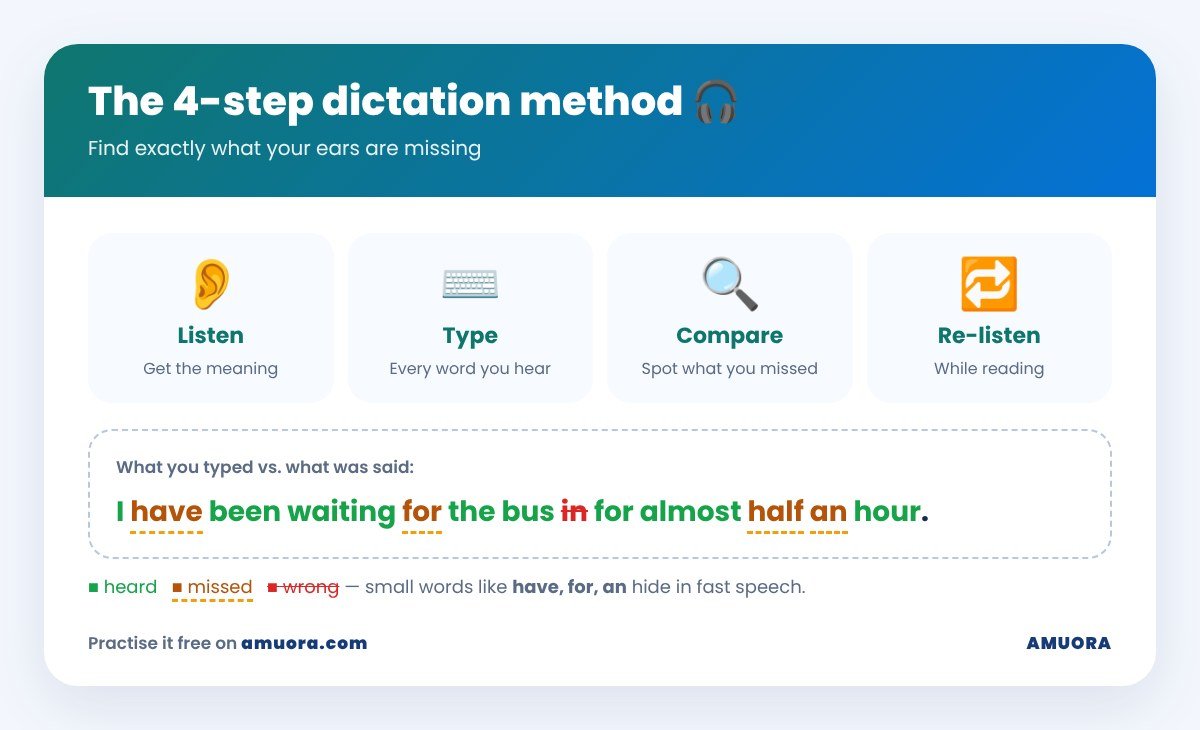
The 4-step dictation method
- Listen once without writing. Get the general meaning.
- Listen and type. Play it as many times as you need. Use the slow version if it helps.
- Compare. Check your sentence word by word. Look at what kind of words you missed.
- Listen again while reading. Now your ears connect the sound with the correct words. This is the moment learning happens.
The words your ears miss most
- Articles: a, an, the
- Auxiliary verbs: have, has, do, does, will, would — often shortened to ’ve, ’s, ’ll, ’d
- Prepositions: to, for, of, at — often pronounced with a weak vowel (/tə/, /fə/, /əv/)
- Endings: -s, -ed, -ing at the end of words
When you notice that you always miss the same type of word, you have found your personal listening problem. Now you can train it on purpose.
Then flip it: after dictation, read the same sentence aloud and let a microphone check your pronunciation. Listening and speaking support each other — the sounds you can produce are the sounds you can hear.
How much is enough?
Five sentences a day is plenty. Dictation is intense — it uses all your attention. Short daily sessions will improve your listening more than a long weekly one.
Start at your level, not above it. If you get less than 60% of the words, choose an easier level. When you regularly score above 90%, move up.
Try it now
AMUORA’s Listen & Speak section has more than 100 sentences from beginner (A1) to advanced (C1). Tap play, type what you hear, and see every word marked green, orange or red. Then switch to Read aloud mode and test your pronunciation with your microphone. It is completely free.
Free, at your level, and it takes about three minutes.