
You can read English. You understand films with subtitles. You know the grammar rules. But the moment someone speaks to you in English, your heart beats faster and the words disappear.
This is one of the most common problems in language learning, and it has a name: speaking anxiety. The good news? It is not a talent problem. It is a practice problem — and practice is something you can control.
Why speaking feels so much harder
Reading and listening are receptive skills: the words come to you. Speaking is productive: you must find words, build sentences, pronounce them and do it all in real time. If you have spent years reading but very little time speaking, your brain simply has not built the “fast road” from idea to sentence yet.
The only way to build that road is to use it. Many times. Even badly at first.
Fluency is not knowing every word. It is being comfortable when you don’t.
The 4-step speaking loop
The fastest learners repeat a simple loop every day:
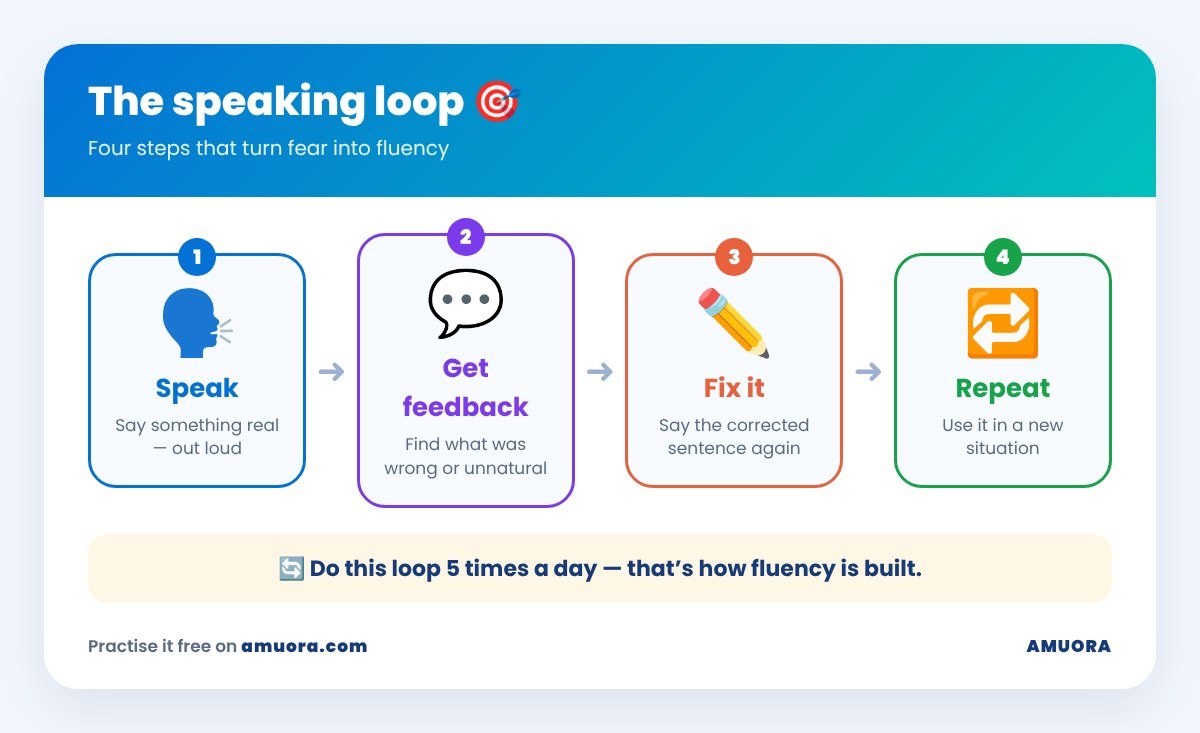
- Speak — say something real, out loud, even if it is simple.
- Get feedback — find out what was wrong or unnatural.
- Fix it — say the corrected sentence again.
- Repeat — use the improved sentence in a new situation.
The problem has always been step 2. Without a teacher or a patient native friend, who corrects you?
Five ways to practise without a partner
1. Talk to an AI speaking partner
This is the biggest change in language learning in years. You can now have a real conversation at any time of day, with no judgement and no waiting. On AMUORA, Amu, our AI speaking partner, replies like a real person, keeps the conversation going with questions, and quietly shows you a corrected version of your sentence after every message.
You can choose real-life role-plays: a job interview, ordering coffee, the doctor, checking in at the airport, or even an IELTS speaking test. Tap the microphone and speak — or type if you are on the bus.
2. Narrate your day
While you cook or walk, describe what you are doing in English: “Now I’m cutting the onions. I think I’ll add some garlic.” It feels strange for two days. Then it becomes a habit that makes English automatic.
3. Shadow native speakers
Play a short clip, pause, and copy the sentence exactly — the rhythm, the stress, the melody. Shadowing trains your mouth the way the gym trains your muscles.
4. Record yourself once a week
Speak for one minute about any topic and save the recording. In a month, listen to the first one. You will hear your progress — and that is the best motivation there is.
5. Prepare your “survival sentences”
Learn a few phrases that save you when you get stuck: “How do you say…?”, “Let me think for a second”, “What I mean is…”. Natives use them too!
Mini challenge: for the next 7 days, speak 5 messages a day with an AI partner. Write down every correction in a notebook. On day 7, read the list aloud. You will be surprised how many mistakes you no longer make.
What to do when you make mistakes
Celebrate them. Seriously. Every mistake you make while speaking is a mistake you are about to fix. People who never make mistakes are people who never speak — and they never improve.
Native speakers do not expect perfect English from you. They expect communication. A friendly smile and a simple, clear sentence will always beat a perfect sentence that never comes out.
Your next step
Choose a situation that matters to you — a job interview, a trip, chatting with new friends — and practise it today for five minutes. Then do it again tomorrow.
Your first conversations are free every day. No judgement, just practice.